If you are struggling with rising shipping costs, inventory issues, or order volume that is outpacing your team, it may be time to outsource fulfillment. I have managed multiple ecommerce operations and worked directly with third-party logistics companies to scale them, so I know how much the right 3PL partner can impact growth and margins.
For this guide, I reviewed the best 3PL companies in 2025 using hands-on experience, provider capabilities, pricing structure, and real user feedback. I focused on 3rd party logistics companies that support small and growing ecommerce brands, whether that means fast order fulfillment, B2B and wholesale support, freight shipping, or full-service supply chain management.
Below, you will find the top 3PL providers that consistently perform well for small businesses and ecommerce sellers, along with guidance on which option fits your fulfillment and shipping needs best.
Best 3PL companies: Which ranked the highest
What is a 3PL provider?
A third-party logistics company provides outsourced logistics services, such as order fulfillment, shipping, freight distribution, and import/export. The best 3PL services ultimately help optimize your supply chain and scale your business. When looking for a 3PL company, try using the free service of WarehousingAndFulfillment.com. They match your needs with over 500 prescreened 3PL fulfillment companies. Visit their site for free quotes.
Visit WarehousingAndFulfillment.com
Best 3rd party logistics companies compared
I’ve personally spent more than a decade managing Shopify ecommerce stores and Amazon private label brands — many of which relied heavily on 3PL providers to scale efficiently. That experience, combined with extensive hands-on research, gave me the insight to evaluate each 3PL’s performance from both a strategic and day-to-day operational perspective.
Every provider in this guide was assessed not just on features and cost, but on how well they support small businesses in real-world scenarios. I’ve also factored in third-party user feedback, integration capabilities, support quality, and how scalable each solution is. You can read more about our process in the methodology section below.

Retail Software Expert at Fit Small Business
Which 3PL company is right for you?
Not sure which 3PL company is right for your business? Take this four-question quiz for our personalized recommendation (you won’t be redirected to another screen):
ShipBob: Best order fulfillment and ecommerce 3PL

Pros
- Two-day shipping within continental US
- Wide global order fulfillment network
- Returns management
Cons
- High storage fees
- Varied and mixed user reviews
- Lacks Etsy and Groupon integrations
ShipBob at a glance
- Fulfillment centers: 60+ globally
- Monthly cost: Starts at $450/month (plus order-based and storage fees)
- Ideal for:
-
- Shopify or WooCommerce sellers shipping nationwide or internationally
- Businesses fulfilling 400-250,000+ monthly orders
- Importers sourcing from other countries to the US (via FreightBob program as a value-added service to those outsourcing fulfillment to ShipBob)
- Fast-growing brands needing future scalability
- Not ideal for: Sellers on Etsy or Groupon; those needing domestic freight
Why I chose ShipBob:
ShipBob is my pick for the best order fulfillment companies for small businesses and one of my recommendations for the best 3PL companies because it is one of the most affordable order fulfillment providers I have evaluated. Its pricing options are SMB- and mid-market-friendly, yet its features are ready to support businesses ready to scale and go global.
ShipBob is also one of the most affordable order fulfillment providers I have evaluated. Its pricing options are affordable, yet its features are ready to support businesses ready to scale and go global. From dropshipping and custom packaging needs to two-day discounted shipping in the continental US (plus same-day options), ShipBob delivers.
For its fulfillment service, ShipBob charges a single fulfillment fee for each order, which includes packaging materials, labor, and shipping costs.
Clients’ bills are assessed and updated daily, and all charges are visible in a fully itemized format from your dashboard. In the same tab, shipping details can be toggled to estimate variable order costs.
We reached out to ShipBob, and they gave us the following ballpark pricing information below. To get pricing for freight and import services, contact ShipBob.
- Onboarding: Full implementation starts at $975, which includes a dedicated implementation specialist who supports you through setup and stays involved for about 30 days after you go live.
-
- Pallet (48 x 40 x 54 inches): $40/month
- Shelf (42 x 12 x 23 inches): $10/month
- Small Shelf (22 x 12 x 14 inches): $7.50/month
- Bin (21 x 7 x 11 inches): $5/month
-
- Cost for the first two hours: $35
- Cost for each succeeding hour: $45/hour
- Picking (B2C, fragile): $0.30 per unit
- Picking (dangerous goods/HAZMAT):
-
- $0.15 per order containing products marked as dangerous goods for merchants onboarded before January 19, 2025
- $0.25 per order containing products marked as dangerous goods for merchants onboarded on January 19, 2025, or later
- Kitting fees: ShipBob charges a combination of flat setup fees and per-action fees for kitting. Kitting fees vary based on how many steps your workflow requires. A kitting order includes:
- Training and workstation setup: $25
- Per-SKU pick: $0.07
- Construct box/packaging: $0.56
- Close box/packaging: $0.04
- Place item in box: $0.10
- Pack in ShipBob packaging: $0.15
- Affix pre-provided label: $0.21
- Affix ShipBob-printed label: $0.26
- Exact label placement: $0.07
- Remove item from package: $0.21
- Remove packaging/insert: $0.28
- Add dunnage (yours or ShipBob’s): $0.11
- Construct divider insert: $0.28
- Wrap item: $0.28
- Seal item with tape or sticker: $0.08
- Inspection: $0.21
- Change item SKU to kit SKU: $0.02
- Fulfillment minimum fee: ShipBob requires merchants to meet a $275 monthly minimum in combined fulfillment and kitting fees. This includes B2C, B2B, and kitting orders, but does not include storage, inbound receiving, or other non-fulfillment costs. A 90-day grace period begins after your first full month of inventory being stored in a ShipBob fulfillment center. After the grace period, the $275 minimum applies monthly.
Note: Prices are based in the US as the country of fulfillment and are subject to a 3% credit card processing fee.
- Global fulfillment in 60+ locations
- FBA prep and returns handling
- FreightBob program for non-US imports
- Discounted 2-day and same-day shipping
- Fully itemized billing with real-time estimates
- Works with UPS, USPS, FedEx, DHL, and regional carriers
- Branded packaging, marketing inserts, and gift notes
- Dashboard with full inventory visibility and cost control
- 99.95% accuracy rate
What ShipBob is missing:
- Integrations with marketplaces: ShipBob doesn’t integrate with Etsy or Groupon. If these platforms are crucial for your business, it isn’t a good fit. Consider Flexport instead.
- Export or domestic freight services: Other than freight shipping and the management of inventory distribution to its network of warehouses, ShipBob does not work freight for non-ShipBob customers. I recommend Redhawk Logistics for North American freight needs.
Red Stag: Best for special product handling order fulfillment

Pros
- Accepts products that are considered dangerous or hazardous
- Fast turnaround times with affordable shipping and handling for oversize items
- Low order minimums and no long-term contracts
Cons
- Only two warehouse locations — not ideal for inventory distribution
- Dashboard and user interface are not user-friendly
- Costly pick-and-pack fees
Read our Red Stag Fulfillment review
Red Stag Fulfillment at a glance
- Fulfillment centers: 2 US locations
- Monthly cost: Custom quotes; higher due to specialized handling
- Ideal for:
- Brands selling furniture, gym equipment, fragile goods, or hazardous materials
- Sellers needing white-glove fulfillment with custom boxing
- Ecommerce companies prioritizing accuracy and packaging over volume-based pricing
- Not ideal for: You sell products that require extra care in packaging, custom boxes, or hazardous goods handling
Why I chose Red Stag Fulfillment:
Red Stag packs your orders with the intention of protecting merchandise and reducing dimensional weight. It can even create custom nonstandard boxes for your products, along with custom packing materials and inserts.
Red Stag also offers excellent customer service and 100% accuracy guarantees with a $50 payout for any error (plus the cost to fix the issue or replace the merchandise). It has just three warehouses in two locations, but can still ship to 97% of US addresses in two days or less. With over 6 million square feet of warehouse space, the service is highly scalable.
Red Stag pricing is custom to each client based on a combination of order volume, package weights, and SKU count. We confirmed this with the Red Stag’s team, and they said they provide free onboarding and discounted rates with carriers.
Note, though, that because of its specialized services, Red Stag may be more expensive than other ecommerce 3PLs. If your business needs only simple storage and fulfillment of lightweight, small, and/or manageable items, consider others on our list.
- Accepts hazardous, fragile, and oversized goods
- Flexible 200-order monthly minimum
- Custom box creation and packing materials
- 30-day risk-free trial
- Same-day shipping with generous cutoffs
- 24/7 monitored warehouses with full liability coverage
- Works with UPS, FedEx, USPS, OnTrac, Amazon
- Industry-leading 0.02% error rate and full-service account support — exceptional client services 7 days/week and specialized stock storage and tracking procedures for its sellers
- 48-hour guaranteed receiving and unloading turnaround time
What Red Stag is missing
- International fulfillment: While it can ship internationally, Red Stag does not have warehouses outside the US. Consider ShipBob for greater distribution options.
- Cost-affordable options for small, lightweight, manageable goods: Red Stag’s operation and pricing are geared towards special handling, so it’s not the most affordable option for easy-to-ship items. We recommend ShipBob.
NTG: Best carrier network for small business freight

Pros
- Discounted quotes for multiple freight-shipping carriers
- Helpful and responsive account managers
- Informative, cloud-based transportation management system (TMS)
Cons
- No third-party order fulfillment or distribution services
- Reported overcharges
- Difficult dispute process
NTG at a glance
- Carrier and warehouse network: 850,000+ drivers, 5,000+ vetted warehouse partners
- Monthly cost: No account fees; commission-based brokerage model
- Ideal for:
- Small businesses managing inbound or outbound freight
- New shippers needing help with freight classification and rate negotiation
- Teams looking to offload freight logistics while maintaining control via digital tools
- Not ideal for: Ecommerce businesses needing order fulfillment or inventory management
Why I chose NTG:
NTG offers small businesses a freight-first logistics solution that’s easy to adopt and cost-effective. There are no fees to open an account, and you can access competitive shipping rates through its massive partner network. Its logistics app, the Beon logistics platform, simplifies booking, tracking, and analyzing shipments, making it ideal for time-strapped business owners who need freight logistics but not full-scale fulfillment.
There’s no added fee or surcharge to use NTG’s brokerage service. You select the freight carrier and shipping rate, and NTG receives a commission from the carrier. Plus, there’s no cost to open an NTG account. Added services, such as freight spend analysis, are available and generally free for regular clients, too.
- LTL, strategic full truckload (FTL), final mile, dry van, flatbed, refrigerated, and drayage shipping
- Short- and long-term storage in over 5,000 vetted warehouses
- Vast carrier network of more than 850,000 drivers
- No minimum shipment frequency
- Advanced proprietary digital logistics platform and transportation management system app
- Logistics app (called Beon) provides mobile, on-demand access to its services, equipped with machine learning capabilities and ecommerce integrations
What NTG is missing
- Fulfillment services: NTG’s freight-focused services include warehousing, but it doesn’t offer inventory management, parcel shipping, distribution, or order fulfillment services. Consider ShipBob, Red Stag Fulfillment, or Flexport.
Redhawk Logistics: Best for freight distribution

Pros
- Access to discounted quotes from 70+ LTL carriers, including project
- Helpful and responsive account managers
- Asset-based warehousing and distribution services
Cons
- No parcel order fulfillment
- Support platform designed for enterprise-level clientele
- Limited network of carriers
Redhawk Logistics at a glance
- Carrier and warehouse network: 3,200+ carriers, 4 Ohio-based distribution centers
- Monthly cost: Quote-based; volume and project discounts available
- Ideal for:
- B2B businesses moving freight across the US, Mexico, and Canada
- Brands that need help optimizing freight class, packaging, and custom routing
- Importers, manufacturers, and construction suppliers moving large or break-bulk cargo
- Not ideal for: Ecommerce sellers needing parcel fulfillment and branded packaging
Why I chose Redhawk Logistics:
Redhawk Logistics is the only 3PL I found with its own proprietary TMS system that integrates with more than 70 LTL carriers. You can use it to compare LTL vs parcel rates, tender shipments, create shipping labels, and get reports and analytics.
Redhawk Logistics can also identify the correct National Motor Freight Classification (NMFC) numbers to help lower your freight class and look for carriers that negotiate volume rates, waive dimensional weights, or ship under a flat class to help reduce your freight spend.
Like NTG, most of Redhawk Logistics’ fees are built into freight shipping and service rates; you submit your needs and receive bids from carriers. Advanced needs, such as distribution, are quoted.
Redhawk Logistics prices are extremely competitive with other top broker services, and it generally delivers low rates, even for occasional and low-volume shippers. Larger accounts can receive volume freight or class-based discounts, too.
- LTL, FTL, specialized heavy haul, intermodal, drayage, break-bulk, dry van, flatbed, and refrigerated shipping
- Short- and long-term storage in four warehouses strategically located in Ohio, with distribution and sort-store-repack services
- Proprietary web-based Transportation Management System (TMS)
- Network of over 3,200 recommended carriers
- Competitive pricing, discounted rates with easy and fast quotes
- Efficient customer services from personal account managers
- Projects and heavy haul services
- Custom inbound routing and optimization software
- Educational online resources
- No minimum shipment frequency
What Redhawk Logistics is missing
- Ecommerce fulfillment: Like NTG, Redhawk Logistics focuses on freight. While it can help with bulk order fulfillment, consider ShipBob or Red Stag for regular ecommerce.
Flexport: Best all-in-one 3PL solution

Pros
- Large warehouse network
- Robust digital logistics software
- Highly rated user reviews
Cons
- Cannot fulfill global Amazon SFP orders
- Pricey storage cost fluctuations
- Higher quotes vs other 3PLs
Flexport at a glance
- Fulfillment centers and network: 40+ US-based warehouses, 80,000+ carrier partners worldwide
- Monthly cost: Varies; typically higher than niche fulfillment-only providers
- Ideal for:
- Small businesses and startups managing international imports or exports
- Merchants selling on Shopify, Amazon, or Walmart that need omnichannel fulfillment
- Businesses looking to consolidate freight, customs, and order fulfillment in one system
- Not ideal for: Brands seeking full control over packaging or low-cost domestic fulfillment
Why I chose Flexport:
With the acquisition of ecommerce fulfillment company Deliverr, Flexport now provides comprehensive ecommerce and wholesale order fulfillment. It can be used as an all-in-one solution to manage your supply chain, or you can select individual services that suit your needs.
Flexport’s primary focus is digital freight brokerage through partnerships with hundreds of carriers, making it well-suited for small businesses, infrequent shippers, and even enterprise-level customers. It can also provide services for businesses that do international importing, logistics, and expansion because of its extensive customs services and global partner network.
Since our last update: Monthly minimum fulfillment spend change
From July 1, 2025, through December 31, 2025, Flexport applies a $500 monthly minimum fulfillment spend to all accounts. Beginning January 1, 2026, that minimum rises to $5,000.
Flexport follows a usage-based pricing structure that includes a monthly minimum fulfillment spend, plus separate charges for storage, wholesale (B2B) fulfillment, non-compliance, and warehouse value-added services.
This minimum is only assessed if your non-D2C storage spend falls below the threshold. Flexport counts costs such as fulfillment, reserve storage, parcel, FTL/LTL booked through the Seller Portal, pallet and case handling, label services, prep, credit card processing, and related warehouse activity toward that total. If your monthly spend is under the minimum, Flexport bills the difference on your next invoice.
In August 2025, Flexport also revised multiple rate categories across B2B, reserve storage, non-compliance, and value-added services. Updates included higher pallet storage rates at the San Bernardino reserve facility, the introduction of shelf-based reserve storage pricing, new wholesale order processing and portal management fees, refreshed inbound non-compliance charges, and a standardized menu of warehouse special-project rates (including prep minimums, hourly inspection fees, cycle count pricing, and certified disposal rates).
- Online marketplace and ecommerce fulfillment from over 40 US warehouses
- Network of over 80,000 carriers
- Advanced online platform for booking, tracking, and analytics, driven by AI
- Warehouse communication tools
- Freight and shipping discounts
- No minimum volume or frequency
- Ocean, air, and trucking freight
- Extensive specialty freight methods
- Online marketplace and D2C order fulfillment
- Robust customs services and global partner network
- Carbon emissions offsetting for consolidated freight services
What Flexport is missing
Full seller control over fulfillment such as branding and custom packaging: Flexport’s order fulfillment is tailored for competitive marketplaces, potentially limiting seller control. For those with independent online stores seeking cost-effectiveness and simplicity, check out Red Stag or ShipBob. Additionally, Deliverr’s restriction on custom packaging compromises branding and unboxing experiences.
When should a small business use a 3PL?
Small businesses should consider outsourcing logistics to a 3PL when fulfillment becomes too costly, time-consuming, or inconsistent. Signs include rising customer complaints, inaccurate inventory, or growth into new sales regions.
Many small businesses start off handling logistics on their own — picking and packing orders, booking freight, and managing deliveries in-house. While this can work well during the startup phase, it often becomes unsustainable as your operations scale.
Here are six clear signs that it’s time to bring in a third-party logistics (3PL) partner:
- Your logistics costs are rising faster than your revenue: You’re spending more on shipping and storage, but your margins are shrinking. A 3PL can reduce costs with bulk carrier discounts, optimized warehousing, and smarter fulfillment strategies.
- Your internal team is overwhelmed: If your employees are spending more time on shipping than on sales or customer service, it’s time for help. A 3PL gives you access to trained logistics pros and additional bandwidth.
- Customer service complaints are increasing: Missed delivery windows, lost packages, and slow shipping damage your brand. 3PLs specialize in reliable fulfillment and fast delivery, leading to happier customers.
- Inventory records are inaccurate or outdated: Stockouts and overstock issues can cost you sales. Many 3PLs offer real-time inventory tracking tools to help you stay accurate and prevent costly errors.
- You’re expanding to new markets or locations: Whether opening a second warehouse or selling internationally, a 3PL can help you scale efficiently without investing in your own infrastructure.
- You want to reduce operational risk: From staffing warehouse labor to managing insurance and compliance, 3PLs take on much of the logistical risk — freeing you to focus on growth.
TIP: If you’re spending more time tracking shipments than building your business, it’s probably time to explore 3PL options.
How do I choose the best 3PL company for my small business?
To choose the right 3PL company, identify your logistics needs, compare provider services and pricing, and evaluate integrations, analytics, and warehouse locations. The right 3PL should align with your growth stage and sales channels, whether you’re fulfilling 100 or 10,000 orders a month.
Once you’ve recognized the need to outsource logistics, the next step is selecting the right 3PL partner to either supplement or fully manage your operations. Here’s a clear, step-by-step guide I recommend:
Step 1: Identify your business’s specific logistics needs
Start by mapping out which tasks you want to outsource and which you want to keep in-house. Ask yourself:
- Do I only need basic fulfillment — pick, pack, and ship?
- Should someone else handle inventory storage and tracking?
- Do I need custom packaging, inserts, or gift notes (kitting services)?
- Do my customers expect 2-day delivery?
- Would real-time inventory syncing improve my operations?
- Do I want the 3PL to manage returns and reverse logistics?
Once you’ve listed your must-haves, rule out any providers that don’t support those features.
Step 2: Set a budget & request multiple quotes
Unlike software tools, 3PL services usually don’t list prices upfront. Expect to go through a quote request process, which helps them tailor pricing to your order volume, product size, and fulfillment needs.
- Ask multiple providers for quotes — you’ll uncover significant price variation.
- Check for volume-based discounts, hidden fees, and minimum monthly requirements.
- Compare value over price — some services may seem costlier but offer better accuracy, faster shipping, or dedicated support.
Step 3: Look for integrations and analytics tools
Most small businesses already use an ecommerce platform like Shopify, WooCommerce, or BigCommerce. Choose a 3PL that offers built-in integrations so your orders and inventory sync automatically.
- Look for integrations with your storefront, marketplaces (like Amazon or Walmart), and accounting tools.
- Ask whether they provide analytics dashboards showing: inventory levels, shipping times, fulfillment costs, and order accuracy and return rates.
Why is this important? Analytics can help you identify slow-moving products, plan restocks, and improve profit margins.
Step 4: Check fulfillment center locations
Where your 3PL has warehouses directly affects shipping speed and cost. A national or international fulfillment network enables:
- 2-day delivery to most US zones
- Distributed inventory strategy (store products closer to your customers)
- Lower last-mile delivery costs
Bonus: Ask if the provider owns or operates the warehouses directly — this can impact service quality and accountability.
How did I evaluate the best 3PL companies for 2025?
I evaluated top 3PL logistics companies based on the services small businesses need most, like ecommerce fulfillment and freight logistics, along with pricing transparency, ease of onboarding, customer service quality, and scalability.
Most small businesses turn to 3PL companies when in-house logistics become too complex, expensive, or time-consuming. While some providers offer end-to-end supply chain management, I found that the best 3PLs for SMBs tend to specialize in order fulfillment, freight brokerage, or a hybrid of both.
My evaluation focuses on how well each 3PL supports the operational realities of small businesses — like low order volumes, rapid growth, and tight budgets.
Evaluation criteria
I selected and ranked the best 3PL for small businesses based on the following key factors:
- Range of services: Most small businesses need a 3PL that covers ecommerce fulfillment, freight management, or both — not an enterprise-level solution with features they won’t use.
- Customer service and support: Logistics is time-sensitive. We prioritized providers that assign dedicated account reps or offer strong client support to help resolve issues quickly.
- Pricing transparency and value: Because 3PL pricing often lacks up-front visibility, we focused on providers with clear billing structures, no hidden fees, and solid value for the services offered.
- Startup-friendliness and scalability: Small businesses need low minimum order requirements, flexible plans, and the ability to scale without massive cost jumps.
- Ease of onboarding: I looked for providers with free or low-cost account setup, self-guided onboarding tools, and resources that make switching or launching easier.
- Software integrations: The best 3PLs connect seamlessly with ecommerce platforms, accounting tools, and inventory systems to prevent costly data mismatches.
- Account management tools: A strong 3PL platform should provide a centralized dashboard where users can track orders, manage inventory, and access real-time shipping updates.
Visual comparison: How top 3PL companies stack up
To help small business owners quickly compare providers, I have visualized how these major 3PL companies perform across the core criteria that matter most — like service coverage, pricing transparency, and ease of onboarding.
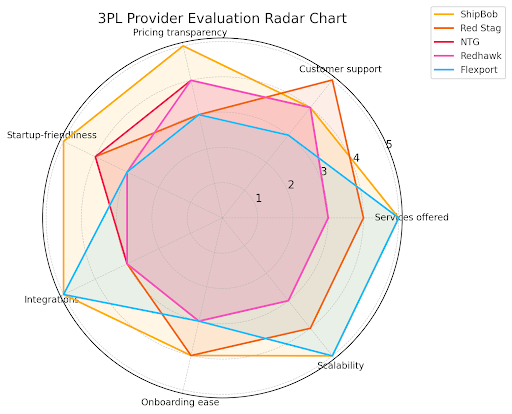
The radar chart above scores each provider on a scale of 1 (poor) to 5 (excellent) in seven key areas:
- Services offered: Range and relevance of logistics solutions (ecommerce fulfillment, freight, returns, etc.)
- Customer support: Availability, responsiveness, and dedicated account management
- Pricing transparency: Clarity around fees, contracts, and hidden costs
- Startup-friendliness: Low minimums, flexible terms, and SMB accessibility
- Integrations: Built-in support for ecommerce platforms and marketplaces
- Onboarding ease: Setup support, documentation, and transition tools
- Scalability: Ability to support growth without steep pricing jumps
Key insights
- ShipBob scores consistently high across all areas, especially for startup-friendliness, services, and scalability. It’s the most well-rounded provider for ecommerce-focused SMBs.
- Red Stag excels in customer support and accuracy handling, making it ideal for sellers of fragile or high-value products. However, it ranks lower in pricing transparency and platform integrations.
- Flexport stands out with global freight capabilities and robust tech integrations. It’s great for international sellers but may be too pricey for startups or low-volume shippers.
- NTG offers strong freight-focused services and hands-on support but lacks ecommerce fulfillment and full inventory management.
- Redhawk is best for B2B and industrial freight shipping. It lags in ecommerce support but provides value for manufacturers and wholesalers with large distribution needs.
Overall, I recommend ShipBob as one of the top 3rd party logistics companies, particularly for ecommerce fulfillment. ShipBob offers affordable fulfillment and import services with the flexibility many small businesses need to thrive. Clear pricing, functional special features, discounted fast shipping, and a large warehouse network put ShipBob ahead of the pack for small business 3PL needs.
Visit ShipBob
Frequently asked questions (FAQs)
Click through the tabs below to find the answers to the most asked questions about 3PL companies.
A 3PL (third-party logistics) provider is a company that offers outsourced logistics services such as warehousing, shipping, and inventory management. Small businesses use 3PLs to reduce costs, improve delivery times, and scale operations without building in-house logistics teams.
Small businesses should consider a 3PL when logistics costs rise, in-house teams are overwhelmed, or shipping delays affect customer satisfaction. Using a 3PL can streamline operations, improve inventory visibility, and support scalable growth.
To choose a 3PL provider, define your business’s logistics needs—such as order fulfillment, freight, or warehousing—then compare providers based on cost, services, integrations, and scalability. Consider fulfillment location coverage and the level of onboarding and customer support they offer.
No, fulfillment companies are a type of 3PL that handle order processing and shipping to customers. A 3PL may offer broader services like freight management, inventory storage, and international logistics beyond order fulfillment.
3PL (or third-party logistics) refers to any third-party service that relates to the planning and organization of how goods are moved, stored, and kept track of. Fulfillment providers are a type of 3PL company that specializes in the process of getting parcels to consumers.
While fulfillment companies focus specifically on receiving, storing, processing, and shipping customer orders, other 3PL companies can help with international freight, customs clearances, and LTL and FTL shipments.
A 3PL handles warehousing and shipping logistics, while a 4PL oversees the entire supply chain, including managing multiple 3PLs. 4PLs offer end-to-end logistics coordination, often used by enterprise-level businesses.
Bottom line
Choosing the right third-party logistics company isn’t just about offloading shipping tasks—it’s about building a partnership that helps streamline operations, improve delivery times, and support long-term growth.
Whether you need ecommerce fulfillment, freight coordination, or both, the ideal provider will align with your sales channels, order volume, and budget. And while there’s no one-size-fits-all solution, taking the time to compare the top 3PL companies can lead to smoother operations and happier customers.
Need help getting started? Check out WarehousingAndFulfillment.com — a free matchmaking service that connects you with over 600 vetted third-party logistics companies based on your specific needs. Get fast, personalized quotes from providers that fit your business goals.
Visit WarehousingAndFulfillment.com