ShipBob and ShipMonk are two of the leading third-party order fulfillment solutions for small businesses. They offer similar platforms built around outsourcing your product storage, inventory management, order processing, shipping, and returns.
We compared ShipBob vs ShipMonk based on price, functionality, ease of use, and special services to identify the differences between the two and help you choose the best option for your business.
We recommend:
- ShipBob: Best overall order fulfillment solution for small businesses
- ShipMonk: Best for crowdfunding ventures and Amazon, Etsy, and Groupon sellers
ShipBob vs ShipMonk Quick Comparison
*Calculated based on the average rating and total numbers of reviews currently available on G2, Capterra, Shopify App Store, and Trustpilot.
When to Use Each

Pros
- Strong proprietary WMS, real-time inventory tools, and broad integrations for both DTC and B2B
- Large global network with 60+ US warehouses and 10+ international locations
- Advanced reporting and analytics software
Cons
- High storage fees
- Cannot fulfill Amazon SFP orders
- Onboarding starts at $975, which can feel steep for very lean teams
Where ShipBob Beats ShipMonk:
- Enterprise-level infrastructure: Wide warehouse network for inventory distribution
- Sophisticated software: Easy-to-use online platform with powerful tools
- Reporting and analytics: Generate a wide range of helpful reports
- Startup-friendly: Growth Plan offers no order minimums plus resources to support growth
- Dropshipping program: Partnerships with big-box retail websites help businesses sell more
- Services for importers: Robust managed freight program
ShipBob is the better choice for most growing small businesses, ecommerce startups, and retail stores expanding into the ecommerce space. It ranked No. 1 in our evaluation of the top fulfillment companies thanks to its sophisticated software, economical pricing, practical special services, and good ease of use.
These capabilities are supported by its robust warehouse network that spans six countries. It leads the pack in SMB ecommerce fulfillment by offering enterprise-level infrastructure and services to businesses of all sizes—while remaining highly affordable.
Read our ShipBob review to learn more.

Pros
- Support from a dedicated customer service rep with client-specific training
- Ample pre-built marketplace integrations
- Amazon Seller Fulfilled Prime-eligible
Cons
- Limited international fulfillment network
- Large amount of alarming negative user reviews
- Difficult to terminate services
Where ShipMonk Beats ShipBob:
- Marketplace connectivity: Integrates with more platforms, including Groupon and Etsy
- Customization: Robust packaging and branding options
- Crowdfunding fulfillment: Specialty programs for fulfilling crowdfunding rewards
- Customer support: Dedicated “Happiness Engineer” assigned to each account
- Quality control: Takes photos of new SKUs and packed orders
- Fulfillment by Amazon (FBA) experts: Adhere to strict FBA prep guidelines
ShipMonk is the better order fulfillment and shipping service for Amazon-focused sellers, multichannel sellers planning to branch out to new marketplaces, and crowdfunding projects.
It lacks the vast warehouse network and infrastructure that ShipBob provides but delivers well-built programs to facilitate cross-border international shipping, subscription box services, and a branded customer experience.
ShipBob vs ShipMonk: Pricing
Both ShipBob and ShipMonk offer accessible and affordable pricing for small businesses. Each company’s fulfillment pricing is primarily based on usage, so you pay for the amount of services you use. But the way each structures their charges varies significantly. Because of this, the more affordable choice for your store depends on your unique products, sales metrics, and business needs.
Take a look at our ShipMonk vs ShipBob comparison of each major cost center below.
There is no setup fee required to start using ShipMonk, which typically means that you’ll be handling the process of onboarding on your own — including stock migration, platform integration, and account setup.
ShipBob’s full implementation package starts at $975 and employs a dedicated implementation specialist who even stays with you for 30 days after going live. This option is less affordable but can create a more hands-off experience and help avoid bumps in the road.
ShipMonk doesn’t charge for inbound inventory receiving as long as your shipments meet its guidelines. These guidelines include having SKUs separated into individual cartons and each bag, box, and/or carton being clearly labeled with SKU number and quantity.
ShipBob charges for receiving by the hour. According to the company, most shipments are received, checked in, sorted, and stored in less than two hours.
ShipMonk’s receiving process doesn’t include many of the services performed by ShipBob during this step. The company calls it “good faith receiving”: employees don’t count products or sort SKUs. They operate under the assumption that the quantity of SKUs listed on each carton aligns with the quantity present in the shipment and the quantity that you ordered.
This method requires less time and labor, which allows ShipMonk to provide the service for free. It’s a great way to save if you have consistent, reliable retail suppliers and/or low-cost goods—but it leaves you vulnerable to the risk of being short-shipped without realizing the error until months down the road.
Both companies provide a storage-optimization service that’s included in the primary cost. Staff use Warehouse Management System software to constantly evaluate the space your goods are occupying and how they could be most efficiently arranged.
For example, if you have a pallet of merchandise at the beginning of the month and 50% of it sells, your fulfillment partner will reorganize the remaining products into bins or shelves. This reduces your storage bill and creates more usable space for the warehouse.
Beyond that shared benefit, ShipMonk’s storage costs are significantly more affordable than ShipBob. Especially if you stock plenty of slow-moving products or maintain a low sale-to-SKU ratio, choosing ShipMonk can help you save on warehousing.
ShipBob charges a single fulfillment fee for each order, which includes pick and pack (up to four items), basic packaging materials, and shipping costs. ShipMonk, on the other hand, charges for each of these cost centers individually. Both companies offer volume discounts.
In our evaluation of these charges (shown below), the total fulfillment fees from each company work out to be very comparable for orders containing a single item. But for multi-item orders, ShipBob’s pricing structure takes the lead in affordability.
Both companies provide similar discounts for major shipping carriers, although ShipBob delivers consistently more aggressive two-day rates.
ShipBob vs ShipMonk: Quality & Functionality
However, ShipMonk offers better connectivity with ecommerce platforms and marketplaces, which is a valuable feature for scaling businesses.
ShipBob
ShipBob uses sophisticated in-house technology throughout its packing and shipping workflows to achieve 99.96% of orders shipping on time and a 99.95% accuracy rate. Furthermore, it promises to complete inbound inventory receiving within five days of arrival.
However, it’s worth noting that ShipBob has recently been criticized on social media and in user reviews for frequent processing delays and order errors, which contradict the company’s reported accuracy rates.
ShipBob offers its clients access to 35 fulfillment centers strategically located across the United States. This enables faster deliveries at lower shipping costs, leading to reduced fulfillment expenses as well as a wider customer base and excellent scalability.
Unlike ShipMonk, ShipBob has the infrastructure to support efficient international expansion, making it the best choice for international sellers. Merchants can use any of the company’s eight global warehouses to provide their target foreign markets with fast and affordable shipping through local fulfillment.
ShipBob operates fulfillment centers in the following regions:
- Melbourne, Australia
- Sydney, Australia
- Toronto, Canada
- Western Poland, Europe
- Manchester, UK
- Birmingham, UK
- Swindon, UK
- Dublin, Ireland
ShipBob works with nine US shipping carriers, and users can achieve two-day shipping anywhere in the US from even just one of the company’s fulfillment centers. Additionally, ShipBob provides access to Prime-like badges that can be displayed on your website to promote two-day shipping and draw in customers.
Like ShipMonk, ShipBob’s fulfillment software features a rate-shopping tool to help you find the best shipping service.
For your international orders, ShipBob offers Delivery Duty Paid (DDP) shipping services that display shipping, tax, and duty costs at checkout, which help to eliminate unexpected fees upon delivery. Sellers can also expand into foreign markets much more effectively by offering local fulfillment through ShipBob’s non-US warehouses.
ShipBob and ShipMonk both offer an extensive list of integrations. ShipBob integrates with fewer ecommerce platforms and marketplaces than ShipMonk, but offers greater connectivity with shipping tools, finance tools, marketing agencies, and CRM platforms.
Here’s a complete list of ShipBob’s direct integrations:
- Ecommerce platforms and marketplaces: Shopify, Shopify Plus, Amazon, BigCommerce, eBay, Magento, Squarespace, Square, Walmart, Wix, WooCommerce, and NetSuite
- Operations, inventory and order management: Brightpearl, Brij, ChannelApe, Cin7, Cogsy, Cymbio, Fulfil.io, Inventory Planner, Linnworks, Logicbroker, Order Desk, PackageBee, Shypyard, Skubana, SPS Commerce, and Zentail
- Returns management platforms: Happy Returns, Loop Returns, and Returnly
- Freight and shipping solutions: DHL, FedEx, UPS, USPS, AfterShip, Anvyl, Echo Global Logistics, EasyPost, FlavorCloud, Flexport, Freightos, Route, Rush, Shippo, and ShipStation
- Ecommerce marketing, customer relationship management (CRM) and customer support: CartHook, CheckoutChamp, EcoCart, Gorgias, Klaviyo, Octane AI, Okendo, Omnisend, Ordergroove, PageFly, Privy, Quartile, Recharge, Rise.ai, Sezzle, Shop Circle, Simplr, Skio, Smartrr, TalentPop, Tydo, Zaius, and Zip
- Custom packaging and design solutions: Arka, Noissue, Packhelp, and Packlane
- Branding, marketing and web development agencies: adQuadrant, Blanka, BVACCEL, eHouse Studio, Envoy, Eventige, Hawke Media, Priceless Consulting, The Stable, MuteSix, ROI Revolution, and SeaMonster Studios
- Accounting, tax, and financing: Avalara, Avask, Bookkeeper360, Canusa Logistics, Clearco, DSP Insurance Services, Firstbase.io, Go Global Ecommerce, Kickfurther, Mercury, OFX, Rho, SimplyVAT, TaxJar, and ZonKeepers
ShipMonk
ShipMonk’s reported accuracy rate is slightly lower than ShipBob, although both companies produce remarkably few errors. Similar to ShipBob, ShipMonk uses fulfillment technology to automate and improve many of its processes.
According to ShipMonk, its machines can pick 4x faster than the industry average and boast a 400% increase in storage efficiency—ultimately leading to lower fulfillment costs for its clients.
However, a large number of ShipMonk reviewers mention frequent packing and shipping errors, which doesn’t align with the company’s reported performance.
ShipMonk’s fulfillment network is smaller than ShipBob’s, but quickly growing. It currently has eight US warehouse locations mainly positioned near the coasts, allowing sellers to store and ship inventory strategically. An additional warehouse in Texas is scheduled to launch soon.
The company also has three international locations: Mexico, Canada, and the UK. According to ShipMonk, a second European warehouse is coming soon.
ShipMonk works with six US shipping carriers. Its software features an intelligent rate-shopping tool that finds the best service for your orders based on price, speed, and carrier performance.
ShipMonk’s warehouse network is based in North America, except for one location in the UK— which limits its global reach for local international fulfillment.
However, sellers can use the company’s cross-border shipping services to fulfill international orders with stock stored domestically. Like ShipBob, ShipMonk offers DDP shipping services.
The company also offers a proactive exception handling service, which will contact your customers to let them know of any problems with their delivery (like delayed delivery or incorrect address).
ShipMonk and ShipBob provide roughly the same amount of pre-built integrations to connect your fulfillment platform to your other ecommerce tools.
However, ShipMonk integrates with more ecommerce platforms and marketplaces—including Groupon and Etsy, which ShipBob doesn’t connect with directly.
Here’s a complete list of ShipMonk’s current integrations:
- Ecommerce platforms and shopping carts: 3dcart, AmeriCommerce, Big Cartel, BigCommerce, Cratejoy, CoreCommerce, CS-Cart, Ecwid, FoxyCart, Magento, MijoShop, Miva, Neto, OpenCart, Oxatis, PayPal, PrestaShop, RevolutionParts, Shopify, Shopify Plus, Soldsie, Squarespace, UltraCart, Volusion, Weebly, WooCommerce, X Cart, Zen Cart, Zoey
- Marketplaces: Bonanza, Bandcamp, Cratejoy, eBay, eBay.ca, eBay.co.uk, eBay.com.au, Etsy, Groupon Goods, houzz, Jane, Jet, Newegg Marketplace, OpenSky, Reverb, Sears, Storenvy, Tophatter, Walmart.com, Wish, Yahoo, Best Buy Marketplace, Marshalls, T.J. Maxx, QVC, Target, Walmart
- Freight and shipping solutions: ShipStation, Rakuten Super Logistics
- Operations, inventory, and order management: Acumatica, Cin 7, DEARsystems, Freestyle Solutions, Skubana, Returnly, GeekSeller, Optoro, Spark Shipping
- Payments, accounting, tax, and financing: BlueVin, Brex, KickPay, Stripe Relay, PayPal
- Marketing and CRM: Fullscreen Direct (StageBloc), Salesforce (Demandware), LaunchBoom
- Multichannel management: Brightpearl, Channel Advisor, ChannelSale, Commerce Cloud, Linnworks, Sellbrite, SellerActive, Stitch Labs, SureDone, QuickBooks Commerce
ShipBob vs ShipMonk: Specialty Services
ShipMonk offers unique branding options and the ability to fulfill Amazon Prime orders and crowdfunding rewards, making it the better choice in this category. Both companies have freight management services and extensive customization options, but neither provider offers climate control, frozen warehousing, or liability insurance.
ShipBob
ShipBob and ShipMonk offer many of the same customization options. ShipBob allows you to train fulfillment staff by sending videos demonstrating how you want each custom-packed order to be done. Other customization options include:
- Custom sender labels that display your brand name
- Customizable gift notes
- Kitting
- Branded packaging
- Marketing inserts
ShipBob is not SFP-eligible, so its users must either
- Participate in the Fulfillment By Merchant (FMB) non-Prime program for their Amazon sales, or
- Have ShipBob prep and send a portion of their inventory to FBA, where it can be fulfilled for Prime orders.
ShipBob has an official partnership with Walmart and is eligible for the site’s “2-Day” badge, which can be used as an alternative to selling on Amazon Prime.
ShipBob offers excellent reporting and analytics services. Its fulfillment platform allows users to track key metrics and visualize data at an advanced level, while ShipMonk’s reporting tools are less robust.
ShipBob’s software can generate reports on peak fulfillment times, promotional impact, expense breakdowns, revenue of orders shipped by day, sales by channel, forecasted demand, sales and quantity of orders by zone, and much more. In addition to helping you track your stats, it maintains up-to-date reports on the company’s own performance and that of major shipping carriers for accountability and market research purposes.
ShipMonk
Packaging customization is a robust feature from both providers, but ShipMonk takes packaging customization a step further by equipping its packing stations with a camera that photographs each customized order just before it’s sealed up. This gives you the opportunity to see exactly how your orders look to the customer and lends to high accuracy.
ShipMonk also offers customizable gift notes, kitting, branded packaging, and marketing inserts.
While both companies offer tracking capabilities, ShipMonk delivers branded tracking pages, as shown below. This service is part of a post-purchase suite called MonkProtect, which also includes delivery protection and an automated claims portal.
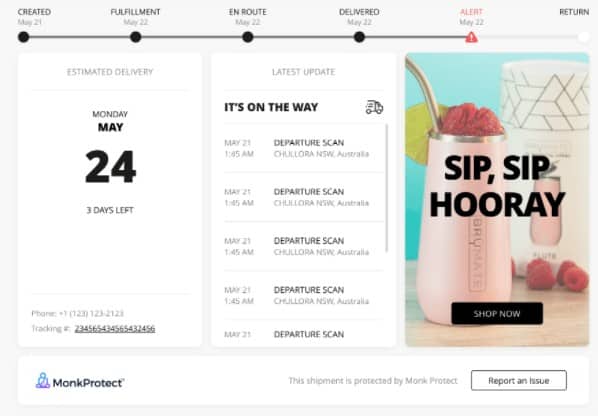
An example of a branded tracking page provided by ShipMonk (Source: ShipMonk)
Unlike ShipBob, ShipMonk is a qualified Amazon Seller-Fulfilled Prime (SFP) provider, making it the better option for Amazon sellers or multichannel merchants who rely on Amazon for a significant portion of their sales.
ShipMonk also offers FBA prep services and claims to specialize in meeting FBA’s complex packaging requirements.
ShipMonk’s reporting features pale in comparison to ShipBob, but its software comes with a helpful analytics suite. Users can set custom parameters to generate a range of reports on:
- Inventory
- Revenue
- Low Stock Alerts
- Total Orders & Items Shipped
- Fulfillment Statuses
- Shipping Destinations
- Top Products
ShipBob vs ShipMonk: Ease of Use
Overall, we found that ShipBob is the easier service to use due to its intuitive fulfillment software and less demanding minimum requirements.
Ease of use is a focus for ShipBob and ShipMonk alike, although clients of both companies report dealing with a learning curve and experiencing difficulties with customer support.
ShipBob
ShipBob users get access to free cloud-based software to manage orders and inventory and handle other operations. Unlike many competing companies, customers report that ShipBob’s software is intuitive and easy to use. It also delivers better functionality than ShipMonk’s online portal.
ShipBob’s software provides visibility into your billing invoices and stock levels across warehouse locations, and reports expected depletions. Additionally, multichannel sellers can manage orders on a unified dashboard or refine reports by channel.
It also allows you to easily manage returns and refunds, although users also have the option to let ShipBob handle returns for you.
Billing is equally transparent with both providers. Your monthly statements are itemized down to the individual charge, and pricing is generally predictable. That being said, users of both ShipBob and ShipMonk report finding hidden charges and having trouble resolving billing discrepancies.
ShipMonk’s minimum monthly billing requirements are similar to ShipMonk, but more generous and startup-friendly. The $250 minimum spend is spread across DTC, B2B, and kitting orders, and it doesn’t kick in until after you’ve been with the company for three full months. And, unlike ShipMonk, this minimum charge doesn’t increase along with your storage fees.
ShipBob’s customer support system is highly accessible, providing extended operating hours and multiple convenient communication channels. Furthermore, the company’s reported average response time is much faster than ShipMonk, despite not providing dedicated account representatives.
ShipMonk
ShipMonk’s software also has high levels of user satisfaction, although it delivers fewer useful functions than ShipBob. Some simple tasks require coordinating with your account rep rather than accomplishing it yourself on the software. Its reporting suite is also less robust.
However, we like ShipMonk’s impressive portal for managing returns and exchanges. The tool allows you to create return labels and monitor the status of each return.
Like ShipBob, you can see your monthly ShipMonk statements itemized down to the individual charge from your online portal. Additionally, ShipMonk’s pricing is highly transparent, allowing you to see the costs for different fulfillment and shipping options in advance.
However, a large number of ShipMonk reviews describe running into hidden charges and extreme billing discrepancies that are difficult to resolve. Some of ShipBob’s clients appear to have the same problem.
ShipMonk’s minimum monthly billing requirement starts at $250 or equals your storage fees. If you don’t hit the minimum spend with your pick and pack fees, you’ll be billed the difference.
ShipMonk employs all of its customer service staff domestically and assigns a dedicated support representative to each fulfillment account, called your “Happiness Engineer.” The service relies on a ticketing system to report and address customer issues.
While the company’s reported response time isn’t as quick as ShipBob, it’s very efficient compared to competitors such as FBA (Fulfillment by Amazon).
Similar to ShipBob, ShipMonk has recently received a lot of backlash from customers claiming that its customer support is unresponsive and ineffective. Users also mention extreme difficulty terminating service with ShipMonk and migrating to another 3PL.
ShipBob vs ShipMonk: Expert Score
ShipBob scored higher in our Expert Review, earning points for its robust services, good value, and excellent usability. Both companies’ popularity could be better, but ShipBob is better-rated in user reviews than ShipMonk.
ShipBob
ShipMonk
How We Evaluated ShipMonk vs ShipBob
To help you find the best fulfillment partner for your small business, we compared ShipMonk vs ShipBob on pricing, functionality, specialty services, and ease of use. Our retail and ecommerce experts also weighed in and evaluated each service.
30%
General fulfillment features
20%
Advanced and niche capabilities
20%
Ease of use and support
10%
Expert and user scores
20% of Overall Score
This category grades how affordable and accessible a provider is for small businesses and how easy it is to understand what you will pay each month. Overall value for money is scored once storage, pick-and-pack, shipping markups, and minimums are factored in, then weighed against how clearly the provider presents its fees and whether you can realistically forecast charges. I also check how friendly the contract terms and minimums are for growing brands, how easy it is to scale up or down, and how much setup fees are, onboarding charges, or other extras that tend to hit small merchants the hardest.
30% of Overall Score
This is the core operational score and carries the most weight. It reflects how well each provider handles the day-to-day work of fulfillment: receiving and checking in inventory, tracking stock accurately at the bin level, and maintaining reliable pick-and-pack accuracy backed by clear expectations or SLAs. I also look at shipping options, how quickly packages can reach customers, and the provider’s carrier coverage. On top of these, I check policies around returns management, the availability of ecommerce and marketplace integrations, and how much real visibility merchants get from dashboards, tracking tools, and operational reports.
20% of Overall Score
Some providers go beyond standard fulfillment, and this category captures those extra capabilities that can be critical for certain brands. I consider how well each service supports kitting, bundling, and light assembly, and whether it is set up for subscription boxes and custom packaging rather than treating them as awkward one-offs. I also look at B2B and retail readiness, including handling pallets, case packs, routing guides, and EDI. International reach plays a role here, with points for clear duties and tax handling and workable cross-border options. Finally, I assess whether the provider can handle specialized storage or handling for heavy, fragile, or regulated items and whether it operates a distributed warehouse network that can actually support multi-node inventory and faster delivery.
20% of Overall Score
Even the strongest feature set fails if the service is hard to adopt or manage, so this category looks at how straightforward it is to get started and stay running smoothly. I evaluate the onboarding experience from importing SKUs and connecting channels through to shipping the first orders, then assess how intuitive the dashboard is for monitoring stock, orders, and issues. Integration setup and ongoing stability matter as well, since broken syncs can ruin an otherwise good operation. I also factor in the quality and responsiveness of customer support across available channels, and how strong the provider’s documentation, help center, and self-service tools are for answering everyday questions without opening a ticket.
10% of Overall Score
To balance the rubric with real-world experience, this category blends my own expert judgment with aggregated customer feedback. My expert score reflects how I rate each provider after reviewing its features, limitations, and fit for small and mid-sized ecommerce businesses. I then add signals from user ratings on major review platforms, looking both at the average score and at how many reviews a provider has, since a high rating based on only a handful of reviews is less meaningful than strong scores backed by a larger customer base.
*Percentages of overall score
ShipMonk vs ShipBob Frequently Asked Questions (FAQs)
ShipBob and ShipMonk are both 3PL (third-party logistics) companies that provide distribution and order fulfillment for a diverse range of retail businesses. Customers who use ShipBob and ShipMonk include DTC ecommerce brands, B2B sellers, expanding brick-and-mortar retailers, subscription box companies, crowdfunding ventures, and dropshippers.
Businesses that face overwhelming numbers of orders can hire ShipMonk or ShipBob to take care of their inventory storage, order processing, packaging, and delivery.
Over 7,000 companies use ShipBob, including:
- Prymal
- Dossier
- Touchland
- Black Claw
- Waveform Lighting
- Ocean & Co.
- BAKblade
- SuperSpeed Golf
- iloveplum
- TB12
- Juspy
- MANSSION
- Ombraz Sunglasses
- Kula Cloth
- EnduroSport
- Boie
- Brummell
- Ample Foods
- SubSubmarine
- MDacne
ShipMonk is used by hundreds of ecommerce and retail companies, including:
- Beard King
- Better Back
- CatLadyBox
- Pipolli
- FEAT Socks
- CurlsUnderstood
- LaRitzy
- calmbox
- e-Retail Society Group
- The Honey Pot
- BhuddiBox
- GeekMyTree
- Color Clutch
- The Airhook
- Airboxlab
- Tenzo Tea
- Saranghae
Bottom Line
Both ShipBob and ShipMonk are very strong choices for SMB order fulfillment and are some of our top recommendations. They are equally affordable for the most part, and each offers robust software to manage your orders and inventory. But the option that’s best for you depends on your specific business needs.
To find more fulfillment options that fit your business, visit FulfillmentCompanies.net. It’s a brokerage service that matches you up with compatible providers, and it’s completely free to use.
Visit FulfillmentCompanies.net