Consulting is one of the fastest ways to turn your skills into income. Starting a consulting business doesn’t require a storefront, inventory, or a big team to get started — just expertise in a specific area and a plan for helping others solve real problems. In 2025, launching a consulting business is easier than ever; however, it’s also more competitive, as clients expect clear value and rapid results.
Quick stats
- Startup costs: $500 to $3,000 (depending on tools, branding, and business setup)
- Skill level: Intermediate to expert (depends on niche and services offered)
- Time to launch: 2 to 6 weeks
- Estimated profit margin: 60% to 85%
In this guide, I’ll walk you through how to start a consulting business that gets clients quickly. You’ll learn how to choose your niche, register your business, price your services, build a simple brand, and attract your first paying clients with practical marketing strategies.
What is a consulting business?
A consulting business provides expert advice to individuals or organizations in exchange for a fee. As a consultant, you help clients solve problems, reach their goals, or improve results using your specialized knowledge.
You need a clear niche, a strong value proposition, and a way to connect with potential clients. Consultants work in nearly any field, from marketing and HR to tech and education.
Step 1: Choose your niche and expertise
Your niche is the foundation of your consulting business. It defines what problems you solve, who you help, and how you position yourself in the market. Trying to be a generalist makes it harder to attract clients, especially when you’re just starting. The more specific your niche, the faster you’ll get noticed.
Top consulting niches in 2025
The consulting industry continues to grow and diversify in 2025, with strong demand in both traditional and emerging sectors. Here are some high-potential niches to consider:
- Marketing and digital strategy: SEO, paid ads, social media, content strategy
- HR and people operations: Hiring, onboarding, culture, compliance
- Financial consulting: Bookkeeping, cash flow management, fractional CFO services
- IT and cybersecurity: Cloud migration, cybersecurity risk, software integration
- Sustainability and ESG: Green certifications, climate reporting, sustainable operations
- Operations and process improvement: Lean systems, SOP creation, automation
- Sales strategy: B2B sales systems, CRM setup, team training
- Diversity, equity, and inclusion (DEI): Policy audits, workshops, inclusive hiring
- Health and wellness consulting: Workplace wellness programs, lifestyle coaching
- AI and tech adoption: Helping businesses understand and implement AI tools
Pro tip: If you’re not sure where to focus, start by looking at the problems people already ask you to help with.
How to find your niche
To identify the right consulting niche, focus on the intersection of your expertise, market demand, and client willingness to pay. Here’s a simple three-part process:
- Assess your skills and experience. What are you already good at? Think about your professional background, certifications, or even side projects where you consistently deliver results.
- Look for urgent, paying problems. Use tools like:
- Google Trends to spot rising interest
- Reddit or Quora to find what people are struggling with
- LinkedIn job posts to identify skill gaps companies are trying to fill
- Check for market fit. Are others already offering this service? That’s not a bad thing — it’s a sign of demand. But look for gaps in how others are delivering, pricing, or positioning.
Do a quick check: Can you clearly say “I help [type of client] solve [specific problem] so they can [result]”? If yes, you’re on the right track.
Step 2: Register your consulting business
Once you’ve chosen your niche, it’s time to make your business official. Registering your consulting business not only keeps things legal; it also builds credibility with potential clients, helps you open a business bank account, and protects your personal assets (if you choose the right structure).
The good news is that starting a consulting business has minimal upfront legal requirements in most areas.
Choose a business structure
Before you can register your business, you’ll need to decide how it’s legally set up. Your business structure affects everything from taxes to personal liability to how much paperwork you’ll need to file each year.
For solo consultants, the most common structures are sole proprietorship, limited liability company (LLC), and corporation. The best choice depends on how much legal protection you want, how you plan to grow, and your tax preferences.
Get an Employee Identification Number (EIN)
An EIN is a unique tax ID issued by the IRS to identify your business. Even if you don’t plan to hire employees, getting an EIN is a smart move for most consultants because it makes your business look more professional and keeps your personal information private.
Here are some of the benefits of having an EIN:
- You can open a business bank account. Most banks require an EIN for account setup.
- It will protect your personal identity. Use your EIN instead of your SSN on contracts, invoices, and forms.
- You can build business credit. It helps establish a financial identity for your business.
- You can hire employees or contractors. You’ll need an EIN if you expand your team.
- It will separate your business and personal taxes. This separation is important if you form an LLC or corporation.
Applying for an EIN is free and only takes a few minutes online. Check our guide on how to get an EIN.
Related: Can I Open a Business Bank Account Without an EIN?
Set up a business bank account
Once you’ve registered your consulting business and received your EIN, the next essential step is to open a business bank account. A business bank account simplifies your bookkeeping and tax filing by keeping income and expenses clearly separated from your personal finances.
It also supports your legal protection, especially if you’ve formed an LLC or corporation, since mixing personal and business funds can weaken your liability shield. Having a dedicated account looks more professional to clients, who often prefer to pay a business rather than an individual.
Over time, it also helps you build business credit, giving you access to financing, credit cards, and other financial tools that support growth. Some consultants skip this step when starting out, but it’s a mistake that can cause problems down the line. In fact, opening a dedicated business account is one of the first things we recommend to new entrepreneurs.
Learn more about why you need a business bank account and when you’re ready, follow our step-by-step guide on how to open a business bank account and how to choose a bank for your small business.
Related:
Consider business insurance
Business insurance might not be the most exciting part of starting your consulting business, but it’s a key step in protecting your work, finances, and reputation. Even if you’re a solo consultant working from home, the right small business insurance can shield you from unexpected legal claims, data breaches, or client disputes.
While consulting is generally a low-risk profession compared to industries like construction or retail, your insurance needs will depend on your niche, the type of clients you serve, and the terms of your contracts.
Here are the most common types of coverage for consultants:
Business insurance costs can range from $200 to $1,500+ per year, depending on coverage, location, and business size. Many providers offer bundled packages tailored to consultants, so you can start with basic protection and scale up as needed.
Related: 6 Best Small Business Insurance Companies
Check local requirements
While consulting businesses are typically low-regulation and often don’t require industry-specific licenses, you may still need to register your business at the city, county, or state level, especially if you’re operating from home, collecting sales tax, or offering paid products beyond one-on-one services.
Here are the most common local requirements to check:
Some jurisdictions also require fictitious business name (DBA) filings if your consulting business name is different from your legal name, and others may have zoning restrictions or noise ordinances for home-based workspaces.
Keep in mind that even if you operate entirely online, your local government may still require registration, especially if you plan to deduct expenses or advertise locally.
Pro tip: Visit your state, county, or city’s official government website to check for business license requirements, zoning rules, and sales tax obligations. You can usually search “[your state] business license” or use your Secretary of State’s website as a starting point.
Step 3: Create a simple consulting business plan
Now that you’ve chosen a niche and registered your business, it’s time to put your ideas into a simple, actionable business plan. Don’t worry — this isn’t about writing a long formal document.
A lean business plan helps you clarify your goals, understand your market, and stay focused as you grow. It also makes it easier to communicate what your business does if you’re seeking partners, funding, or just explaining your services to clients.
Even a one-page plan is better than none at all. The goal is to define how your consulting business will operate, make money, and deliver value.
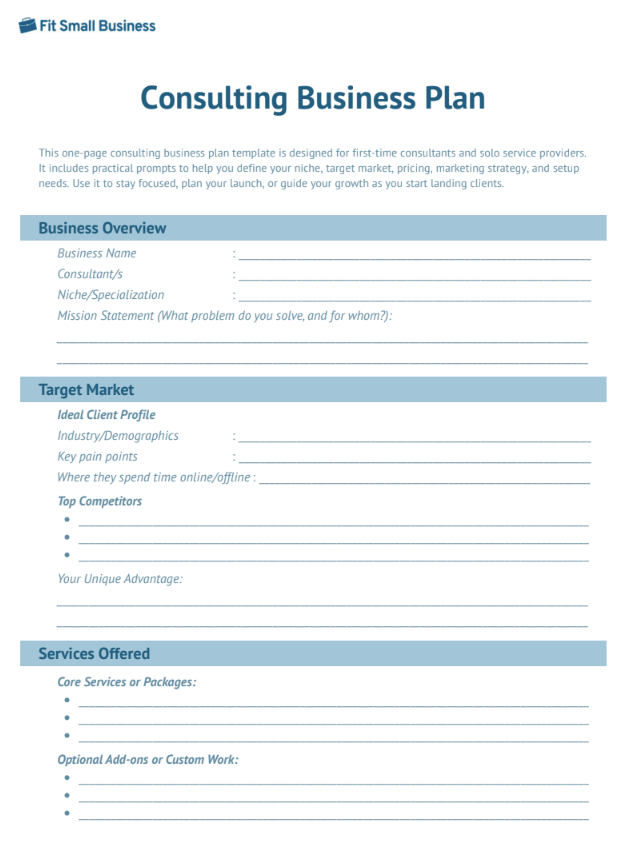
Here are the essential elements of a simple consulting business plan:
Free consulting business plan template
If you’re not sure where to begin, grab our free consulting business plan template to fill in your details. You can complete it in under an hour and revise it as needed.
Thank you for downloading!
Related:
Step 4: Define your ideal client
Do not just engage “anyone who needs help.” If you try to speak to everyone, there’s a good chance you end up resonating with no one at all. To get clients faster and build lasting relationships, you need to clearly define your Ideal Client Profile (ICP).
Your ICP is a detailed description of the type of client you want to work with. Knowing exactly who you serve allows you to tailor your messaging, marketing, services, and pricing in a way that directly appeals to the people most likely to hire you.
It should go beyond just basic demographics. It includes psychographics like goals, values, and decision-making behaviors, as well as practical factors like budget, industry, and preferred communication channels. The more specific you are, the easier it becomes to attract the right leads and filter out the wrong ones.
To help you build a clear profile, use our step-by-step guides:
Pro tip: Start with one clear ICP, even if you can serve multiple types of clients. You can always expand later once your business gains traction.
Step 5: Craft your value proposition
Once you’ve defined who your ideal client is, the next step is to clarify why they should choose you. Your value proposition is a short, clear statement that explains what you do, who you help, and the benefit clients get from working with you.
A strong value proposition sets you apart from other consultants and helps potential clients quickly understand why you’re the right person to solve their problem. It influences everything from your website headline to your email outreach and social media bios.
What makes a good value proposition?
Your value proposition should answer three key questions:
- What problem do you solve?
- Who do you solve it for?
- Why should they choose you over someone else?
Use this simple formula to get started:
I help [ideal client] solve [specific problem] so they can [desired result], using [your unique approach or strength].
Here are a few examples:
- “I help early-stage SaaS founders build scalable content marketing systems that generate leads, even with a small team.”
- “I help HR managers at mid-sized companies create DEI strategies that actually improve employee engagement, not just check a box.”
- “I help executive coaches attract high-ticket clients through LinkedIn without spending on ads.”
Tips for sharpening your value proposition
A strong value proposition should be specific, results-oriented, and easy for your ideal client to understand. Here’s how to make yours more effective:
- Skip the buzzwords. Avoid vague terms like “strategic solutions” or “holistic support.” These don’t communicate what you actually do or how you help.
- Use your client’s language. Speak the way your target clients talk about their own problems and goals. This builds instant relevance and trust.
- Lead with results. Don’t just describe your service but explain what outcomes clients can expect, like saving time, boosting revenue, or reducing stress.
- Highlight your differentiator. What makes you different? It could be your niche, your process, your background, or the speed of your results.
Instead of: “I help businesses improve their operations”
Try: “I help boutique law firms streamline their client intake process to save 10+ hours per week.”
Avoid the “generalist problem solver” trap
Many new consultants try to appeal to everyone by keeping their value proposition broad and flexible, offering “business strategy” or “general advisory.” But being too general makes it hard for potential clients to know what you actually do or who you’re best suited for.
Start with one clear problem for one specific type of client. Once you’ve built momentum, you can expand your offerings or positioning.
Once you’ve drafted your value proposition, test it in the real world, such as on LinkedIn, your website, or in email intros. If people quickly understand it and show interest, you’re on the right track. If not, refine it until it clicks.
Step 6: Choose your business model and set pricing
How you package and price your consulting services directly affects your income, workload, and ability to scale. There’s no one-size-fits-all approach — your model should match your expertise, client expectations, and long-term goals.
It’s important to learn how to pick the right business model for your consulting work and set pricing that reflects the value you deliver.
Common consulting business models
There are several ways to offer your consulting services. You can use one or combine a few, depending on your niche and client needs:
Pro tip: If you’re just starting out, project-based or productized services are often easier to sell than open-ended hourly rates.
How to price your services
Pricing is part strategy, part positioning. Instead of pricing based on your time, aim to price based on the value your service delivers.
1. Research industry benchmarks
Use sites like Glassdoor, Clarity.fm, and consulting forums to see what others in your niche charge. This gives you a starting point but don’t copy blindly. Your experience, geography, and positioning also matter.
2. Calculate your minimum acceptable rate
Add up your expenses (business tools, taxes, insurance, etc.) and income needs. Use this to establish a floor rate, which is the minimum you need to charge to make your consulting sustainable.
3. Shift the conversation to value
Clients don’t just want your time; they want results. Frame your pricing around outcomes:
Instead of “$150/hour,” say, “This $2,000 package helps you reduce onboarding time by 40% within two weeks.”
4. Anchor with packages
Offering tiers (e.g., Basic / Standard / Premium) gives clients options and helps you upsell. Productized services work well with this structure, and they make your value easier to understand.
Pro tip: Many new consultants undercharge, thinking lower prices will help them land clients faster. But low pricing often signals inexperience and attracts the wrong kind of clients. Start with pricing that reflects your expertise and the results you deliver. You can always adjust later as you gain experience and data.
Related:
Step 7: Build your brand and online presence
Your brand is more than a logo. It’s how clients perceive you. It’s the combination of your message, visuals, voice, and reputation. As a consultant, your online presence is often your first impression, so it needs to be professional, clear, and aligned with the type of clients you want to attract.
It is important to establish a simple but effective brand and build an online presence that helps you get discovered and hired.
Start with brand identity basics
Before you build a website or create content, define the core elements of your brand. It doesn’t need to be fancy to be effective; it needs to be consistent and clear.
- Business name: Choose a name that reflects your niche, is easy to remember, and doesn’t limit future growth. You can use your own name or a branded business name.
- Tagline or positioning statement: Summarize what you do and who you help in a sentence. (E.g., Helping healthcare startups scale through better systems and strategy.)
- Visual identity: Pick one to two brand colors, a clean font, and a simple logo. You don’t need to spend big. Tools like Canva and Looka can help you get started affordably.
- Voice and tone: Decide how you’ll sound in your content: friendly, expert, witty, direct? Keep it consistent across all touchpoints.
Need fast, affordable branding materials? Use VistaPrint to create professional business cards, branded stationery, and logo-ready merch. It’s a quick way to look polished when meeting potential clients or sending materials.
Recommended reading:
Build a simple, high-impact website
Your website doesn’t need to be complex. Focus on clarity and credibility. At a minimum, include these five core pages:
If you’re not ready for a full website, start with a one-page landing site using tools like Carrd, Squarespace, or Wix. When you’re ready to build a full website on your own domain, Bluehost offers affordable hosting with one-click WordPress installation, perfect for consultants who want more control and scalability.
Helpful resources:
Establish your online presence
Your website is your home base, but clients often find you through other platforms. Here’s where to show up:
- LinkedIn: Optimize your headline and “About” section using your value proposition. Share helpful insights or repurpose blog content to build authority.
- Google Business Profile: If you serve clients locally or want to rank in Google search results, create a free profile to appear in Maps and local listings.
- Other Channels (Optional): Depending on your audience, consider platforms like Instagram, YouTube, or Substack but only if you can maintain them consistently.
Create trust signals
When someone lands on your website or LinkedIn profile, they’re often asking one silent question: “Can I trust this person to help me?” As a new consultant, especially without a long list of past clients or case studies, it’s important to establish credibility in other ways.
Trust signals are visual or verbal cues that reduce perceived risk for potential clients. These signals help reassure prospects that you’re professional, experienced, and capable of delivering results. They don’t need to be flashy or complicated; what matters is that they speak to your reliability and expertise.
Start with a few simple but effective elements:
- Professional photo: A clear, friendly headshot instantly boosts credibility. No casual selfies—this is your personal brand.
- Logo and consistent branding: Even basic visual consistency (colors, fonts, layout) makes you look more polished and trustworthy.
- Client testimonials or mini case studies: Use short, specific praise from past clients, beta testers, or even former employers or coworkers.
- Lead magnet (optional): Offering a free resource like a checklist, worksheet, or short guide shows generosity, builds authority, and starts your email list.
Pro tip: If you’re just starting and don’t have client testimonials yet, use pilot clients or offer a discounted beta package in exchange for honest feedback and a quote you can use publicly.
Step 8: Set up your marketing funnel
Once your brand and website are in place, it’s time to bring in potential clients. That’s where your marketing funnel comes in. A marketing funnel is the path people take from discovering you to hiring you, and every consultant, no matter the niche, needs one.
Your goal isn’t just to post content or run ads. It’s to build a simple, repeatable process that attracts the right people, builds trust, and guides them toward booking a consultation or buying your service.
The 3 stages of a simple marketing funnel
You don’t need a complicated setup to get started. Most successful consulting funnels include just three key stages:
You can start simple with one traffic source, one lead magnet, and one call to action is enough to begin getting traction.
Free and organic marketing channels for consultants
If you’re on a budget or prefer long-term strategies, focus on organic methods. These take time to build but compound over time:
- LinkedIn: Great for B2B consultants. Optimize your headline and About section with your value proposition. Post 2–3x a week with tips, case studies, or thought leadership.
- SEO & blogging: Target the questions your ideal clients are already Googling (e.g., “how to reduce employee turnover” or “brand messaging tips for startups”). Use tools like Ubersuggest or Google’s autocomplete to find keyword ideas.
Find the right keywords using Semrush. Research what your ideal clients are searching for and build blog content that ranks. Semrush helps you uncover SEO opportunities and track performance over time.
- YouTube or podcast guesting: Build trust quickly by sharing your expertise in video or audio format.
- Email marketing: Send regular, helpful content to subscribers. You can start with a free tool like MailerLite or ConvertKit.
If you’re not sure what to post or what content to share, start by turning your service process into content. Share the “what,” explain the “why,” and give a taste of the “how.”
Grow your network and attract leads with LinkedIn. Use your profile headline to share your value proposition and post weekly content that speaks directly to your ideal client. It’s one of the most effective platforms for organic B2B lead generation.
Recommended reading:
Paid marketing
Paid ads can help you accelerate growth once you’ve validated your offer and messaging. But they’re best used after you’ve seen some traction from organic channels.
- Google Ads: Target keywords with buying intent (e.g., “leadership consultant near me” or “hire a sales consultant”)
- LinkedIn Ads: Effective for high-ticket B2B services, but can be expensive
- Facebook/Instagram Ads: Great for driving traffic to lead magnets, webinars, or newsletter signups
You can start with a small test budget and refine your offer, audience, and messaging before scaling up.
Lead magnets
A lead magnet is a free resource you offer in exchange for a visitor’s email address. It helps you stay in touch with warm leads and continue nurturing them with valuable content.
Popular lead magnet ideas for consultants include:
- Checklists (e.g., “10 Mistakes to Avoid When Hiring a Marketing Consultant”)
- Short templates (e.g., proposal outlines or audit tools)
- Free assessments or quizzes
- Introductory webinars or workshops
- Industry-specific guides
Make sure your lead magnet solves a real problem your ideal client cares about and aligns with the service you eventually want to sell.
Call to action
Every stage of your funnel should have a clear call to action (CTA), whether it’s “Download the guide,” “Book a discovery call,” or “Reply to this email.” Your CTA is the bridge from interest to conversion.
Keep it simple. One strong CTA is better than five scattered ones.
Setting up a clear marketing funnel, even a simple one, makes it easier for clients to discover you, understand your value, and say yes.
Bottom line
Starting a consulting business in 2025 is more accessible than ever but turning it into a client-generating venture takes focus and execution. Begin by choosing a clear niche, registering your business, defining your ideal client, crafting a strong value proposition, setting your pricing, building your brand, and creating a simple marketing system.
After setting up your consulting business, the next phase is to land your first clients. Tap into your network, offer a pilot package, and solve a specific problem for someone who needs it. From there, focus on managing and growing the business. Refine your processes, build client relationships, and look for ways to increase your impact and revenue over time.
Frequently asked questions (FAQs)
Click through the sections below to read answers to questions about how to start your own consulting business:
In most cases, consulting businesses don’t require a specific professional license. However, some local governments may require a general business license or a home-based business permit, especially if you’re operating from home. Check your city, county, or state’s website to confirm what’s needed in your area.
Income varies widely depending on your niche, experience, business model, and client base. New consultants often start at $50 to $150 per hour or $1,000 to $5,000 per project. With experience and clear positioning, consultants can earn significantly more, especially with retainers or productized services.
Some consultants land their first client within a few weeks, especially if they tap into their existing network. Others take a few months to refine their offer and build trust online. The fastest path usually involves direct outreach, a focused niche, and a clearly defined problem you solve.
You don’t need a full website to get started, but you do need a professional online presence. Many consultants begin with a one-page site or a well-optimized LinkedIn profile. As you grow, a simple website helps establish credibility and gives potential clients a place to learn more and book a call.