RingCentral is the better overall UCaaS platform for most small businesses because it offers transparent pricing, extensive integrations, strong call management, and built-in AI productivity tools in one scalable communications system. However, 8×8 is still a strong choice for businesses with global communications needs, especially those that prioritize international reach, large-scale video meetings, and a platform that can connect voice, video, messaging, and contact center workflows.
In this 8×8 vs RingCentral comparison, I evaluated both platforms based on pricing, phone features, video conferencing, team collaboration, international calling, integrations, AI tools, and overall value for small businesses.
| Provider | Best for |
| RingCentral | Best for businesses that want a feature-rich UCaaS phone system with extensive integrations, AI assistance, and advanced call management. |
| 8×8 | Best for companies that need global calling infrastructure, larger video meeting capacity, and a unified communications platform that can grow into a contact center. |
I looked at the subscription plans from RingCentral and 8×8 to compare the packages. I also tested each piece of software and reviewed user feedback on popular review websites. From there, I created a scoring system based on the following categories: pricing, video meeting capabilities, collaboration features, ease of use, integrations, and security.
Here’s a complete breakdown of the factors I considered when comparing 8×8 vs RingCentral:
- Pricing: I compared RingCentral’s and 8×8’s monthly per-user costs and the inclusive features available at different tiers. I also looked at whether a free plan, a free trial, and discounts for annual billing and volume purchases are available.
- General features: I considered essential video conferencing capabilities, such as screen sharing, meeting recordings, and breakout rooms. I awarded higher points to providers with greater participant capacity and longer meeting durations.
- Ease of use: For firsthand experience, I used each platform for specific activities to assess how user-friendly the interface is for tasks such as scheduling a meeting or starting a video conference. In addition, I considered the ease of setup and installation.
- Integrations: I explored how each platform supports third-party integrations, including the number and types of software it supports. I also considered how RingCentral and 8×8 operate within their respective product ecosystems.
- Expert score: I analyzed each product’s value by looking at total costs and feature sets. I also checked user reviews to assess the overall popularity of both platforms, taking into account my own experiences.
Fit Small Business is committed to providing objective business software recommendations. Our VoIP and UCaaS reviews are based on hands-on product research, provider documentation, pricing analysis, feature comparisons, and small business use cases, including call management, remote work, team messaging, video meetings, international calling, and customer communications.
For this RingCentral vs 8×8 comparison, I reviewed the current product pages for RingCentral RingEX and 8×8 Work, compared key features and plan positioning, and evaluated which platform is best suited to different small-business communication needs. I also considered my experience with the platforms and their overall value for small teams and growing businesses.
RingCentral vs 8×8 at a glance
|
RingCentral |
8×8 |
|
|
Monthly starting price per user |
Starts at $20 per user, per month when billed annually |
Quote-based pricing |
|
High-definition audio and video conferencing |
Online meetings included with RingEX; participant limits vary by plan |
HD video for up to 10,000 participants, plus live streaming |
|
Unlimited domestic calling in the U.S. and Canada |
✔ |
✔ |
|
Multi-level auto-attendant |
✔ |
✔ |
|
Internet fax |
✔ |
✔ |
|
International calling |
International calling plans and bundles available |
Native phone service in 50+ countries |
|
Integrations |
500+ third-party apps and integrations |
Prebuilt integrations, CRM syncing, and open APIs |
|
AI features |
AI Assistant with transcription, summaries, action items, text drafting, translation, and meeting highlights |
Built-in AI for meeting summaries, live transcription, chat recaps, noise suppression, voicemail-to-text, and call analytics |
|
Customer support |
24/7 support options vary by plan |
8×8 support, community, university, and service status resources |
|
For more information |
Visit RingCentral |
Visit 8×8 |
What are the best alternatives to RingCentral and 8×8?
While 8×8 Work and RingCentral RingEX are excellent options for small businesses that need a robust VoIP phone system or a full UCaaS platform, they may be more than some freelancers, solopreneurs, and small teams need. If you want simpler pricing, fewer collaboration tools, or a phone system built mainly for basic calling, consider a lower-cost or more streamlined alternative.
A few of the best 8×8 and RingCentral alternatives include the following:
- Nextiva: Choose Nextiva if you want a business phone system with strong call management, team communication tools, and plans that can scale with your team. It is a good fit for small businesses that want a polished VoIP platform but do not need the full complexity of RingCentral or 8×8.
- Grasshopper: Grasshopper is best for solopreneurs and very small teams that want a virtual phone system without per-user pricing. It does not offer the same UCaaS features as RingCentral or 8×8, such as advanced video meetings or deep integrations, but it includes business calling, texting, and extensions with easy access to virtual phone numbers.
- Ooma: Ooma Office is best for small teams that want an easy-to-use VoIP phone system with straightforward per-user pricing. It includes business calling, mobile app access, a virtual receptionist, and toll-free minutes, with plans starting at $19.95 per user, per month. It is a better fit than RingCentral or 8×8 for businesses that want reliable phone service without a large UCaaS learning curve.
Which provider has better pricing? RingCentral
|
RingCentral |
8×8 |
|
|
Monthly plans |
Core, Advanced, and Ultra |
Quote-based pricing |
|
Starting price |
Starts at $20 per user, per month when billed annually |
Not publicly listed |
|
Annual billing discount |
Save up to 33% by paying annually |
Not publicly listed |
|
Free trial |
14 days for up to 20 phone lines |
Not clearly advertised |
|
Best pricing advantage |
Transparent plan pricing and published annual savings |
Custom quotes for businesses with global or bundled UCaaS/contact center needs |
RingCentral wins for pricing because it publishes RingEX plan pricing and annual billing discounts, making it easier for small businesses to estimate costs before speaking with sales. Its free trial also lets new users test RingEX features, including voice, auto attendant, online meetings, team messaging, fax, and conferencing, before committing to a paid plan.
8×8 used to be the clear pricing winner when its Express and X Series prices were publicly listed. However, the current 8×8 site positions 8×8 Work as an enterprise-grade UCaaS platform and routes pricing inquiries to “Request Quote,” which can be frustrating for teams still in the buying phase or comparing options.
That said, 8×8 may still offer competitive custom pricing, especially for companies that need global calling, contact center tools, or bundled communications services, but buyers must contact sales to confirm costs. For small businesses that want predictable, easy-to-compare pricing, RingCentral is the stronger choice.
Which provider is better for video conferencing? 8×8
|
Video conferencing feature |
RingCentral |
8×8 |
|
Meeting capacity |
Online meetings included with RingEX; capacity varies by plan |
HD video for up to 10,000 participants with live streaming |
|
Best use case |
Small business meetings, internal collaboration, and routine team check-ins |
Webinars, company-wide meetings, large events, and global team sessions |
|
AI meeting tools |
AI Assistant can generate transcriptions, summaries, action items, meeting highlights, and chapters |
Built-in AI includes live transcription, smart summaries, noise suppression, and AI-generated action items |
|
Collaboration tools |
Screen sharing, team messaging, conferencing, and meeting productivity features |
Whiteboards, closed captioning, translation in 50+ languages, polls, reactions, and screen sharing |
8×8 wins for video conferencing because it offers a much higher published meeting capacity than RingCentral and includes large-event features like live streaming, closed captioning, translation, polls, and reactions. Its built-in AI tools also support live transcription, smart summaries, noise suppression, and action items, making it a stronger option for businesses that regularly host large meetings, webinars, or distributed team sessions.
As someone who has attended multiple RingCentral events, I still consider it a strong choice for everyday video conferencing and virtual meetups, especially for small businesses that want calling, messaging, video, fax, and AI productivity features in one RingEX plan.
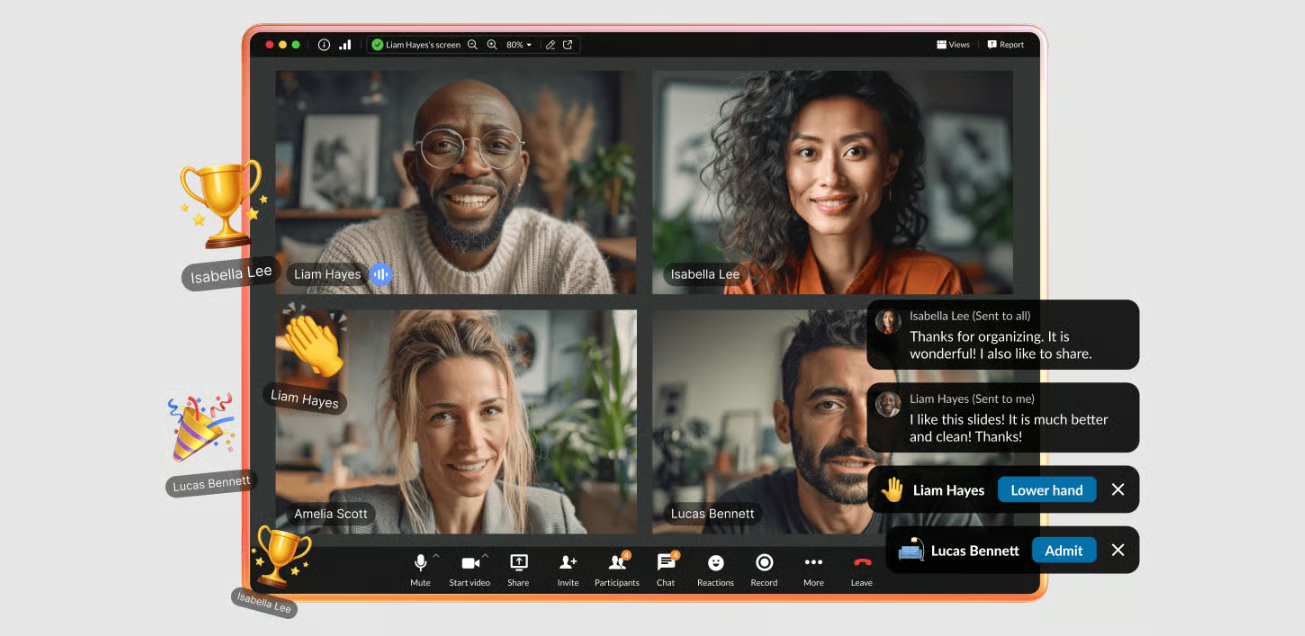
Its AI Assistant can generate meeting highlights, chapters, transcripts, summaries, and action items, making it useful for routine team collaboration and follow-up. However, if video conferencing capacity and large-meeting features are the deciding factors, 8×8 is the better fit.
Which provider is better for team collaboration? RingCentral
|
Team collaboration feature |
RingCentral |
8×8 |
|
Team messaging |
Team messaging is included with RingEX, alongside calls, meetings, fax, and conferencing |
Persistent private and public channels, direct messaging, and threaded replies |
|
AI collaboration tools |
AI Assistant can draft and polish team chats, translate texts and chats, summarize meetings, and create action items |
AI writing tools, meeting summaries, live transcription, chat recaps, and smart noise suppression |
|
File sharing and search |
File sharing and collaboration tools available in the RingCentral app |
File sharing, threaded replies, cross-device sync, and full message search |
|
Meeting follow-up |
AI-generated meeting summaries, highlights, chapters, transcriptions, and action items |
AI-generated summaries, action items, and live transcription |
|
Best fit |
Teams that want calling, messaging, video, fax, AI tools, and integrations in one small business-friendly UCaaS app |
Distributed teams that want persistent channels, file sharing, AI summaries, and cross-device messaging in one app |
RingCentral wins for team collaboration because RingEX brings everyday communication tools into one app, including phone, messaging, meetings, fax, conferencing, and AI Assistant features. It is especially useful for small businesses that want a single hub for internal conversations, customer calls, video meetings, and follow-up tasks without switching between separate tools.
RingCentral’s AI Assistant also strengthens collaboration by helping users draft and polish team chats, translate messages, and turn meetings into summaries, highlights, chapters, and action items. This makes it easier for teams to catch up after calls, follow through on next steps, and keep work moving across departments.
8×8 Work is also strong for collaboration, especially for teams that rely on persistent channels, threaded replies, file sharing, cross-device sync, full message search, and built-in AI tools. But I find it’s a better fit for organizations that want team collaboration closely integrated with global communications and contact center workflows. However, for most small businesses that are comparing collaboration tools, RingCentral offers a more familiar and flexible collaboration experience.
Which provider is better for international calling? 8×8
|
International calling feature |
8×8 |
RingCentral |
|
Global phone service |
Native phone service in 50+ countries |
International calling plans and add-ons available |
|
Best international use case |
Businesses with distributed teams, global customers, or offices in multiple countries |
U.S. and Canada-based businesses that occasionally call international numbers |
|
Domestic calling |
Unlimited calling available; confirm country and plan details with sales |
Unlimited calling in the U.S. and Canada |
|
Global reliability |
Patented Global Reach technology for international voice service |
International calling supported through RingCentral plans and bundles |
8×8 wins for international calling because it is built around global communications, with native phone service in 50+ countries and a platform designed for distributed teams and customer conversations across markets. Its Global Reach technology helps optimize call routing and voice quality across international networks, which is especially valuable for companies with frequent cross-border communication needs. This makes it a stronger fit for businesses with international employees, clients, or offices.
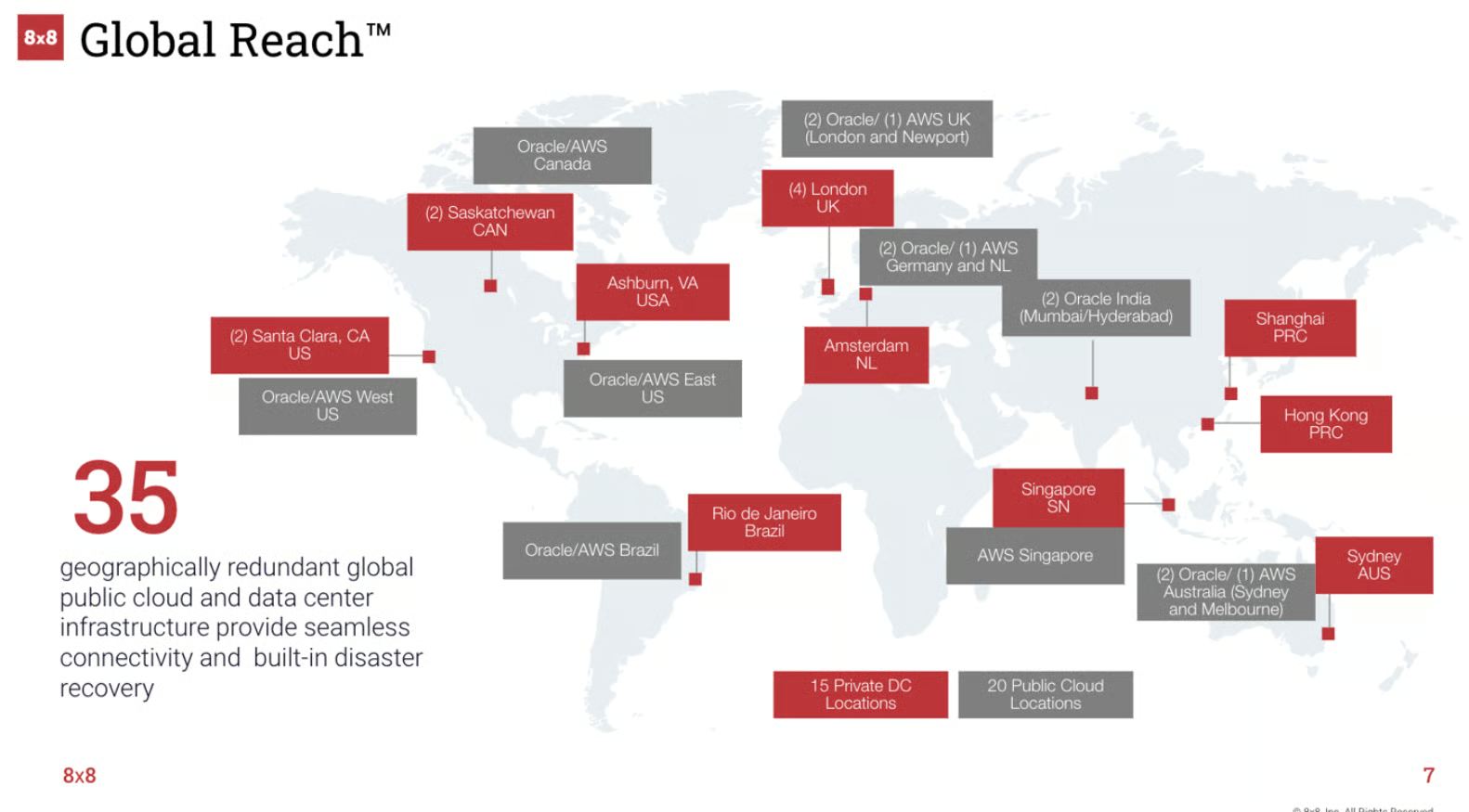
But for teams primarily operating in the US and Canada, RingCentral’s RingEX plans are still a strong option, especially if your international calling is occasional. However, businesses with frequent international calling needs should compare RingCentral’s international rates and add-on plans with 8×8’s quote-based global phone service before making a decision.
Overall, for companies with global teams or customers, 8×8 is the better starting point. For businesses that mainly need unlimited domestic calling with occasional international calls, RingCentral may still be the more straightforward choice.
Which provider is better for integrations? RingCentral
|
Integration feature |
RingCentral |
8×8 |
|
Integration count |
500+ tools, CRMs, and business apps |
Prebuilt integrations, CRM sync, and open APIs |
|
Notable app categories |
CRM, productivity, customer support, analytics, automation, and workflow tools |
CRM, CX, business apps, contact center tools, and team productivity apps |
|
Notable integrations |
Salesforce, HubSpot, Zendesk, Microsoft Teams, Google Workspace, and AWS Marketplace |
Salesforce, Zendesk, Microsoft Dynamics 365, Google Workspace, and more |
|
API support |
Open APIs for custom integrations and workflow automation |
Open APIs and call/contact data synced to CRM |
|
Best fit |
Businesses that want the broadest app marketplace and more plug-and-play workflow options |
Businesses that want UCaaS integrations connected to CRM, CX, and contact center workflows |
Whenever I do a comparison article, RingCentral wins for integrations because it offers the broader app ecosystem, with more than 500 tools, CRMs, and business apps. The app marketplace highlights prebuilt connections for popular platforms like Salesforce, HubSpot, Zendesk, Microsoft Teams, and Google Workspace, plus open APIs for businesses that want to build custom workflows.
However, 8×8 Work is not lacking in integrations, especially for businesses that want communications connected to CRM, customer experience, and contact center workflows. It also offers integrations with Salesforce, Zendesk, Microsoft Dynamics 365, Google Workspace, and more, as well as CRM data sync and open APIs.
But if integrations are important to your tech stack, choose RingCentral for its wide variety of plug-and-play integrations. However, if your integration needs are more focused on customer relationship management and contact center data, 8×8 is still a good choice.
Which provider is better for call management? RingCentral
|
Call management feature |
RingCentral |
8×8 |
|
Auto attendant and routing |
Auto attendant, call routing, call transfer, call forwarding, call delegation, and call screening |
Auto attendant, intelligent call routing, ring groups, and call queues |
|
Voicemail tools |
Visual voicemail and voicemail management tools |
Voicemail-to-email and voicemail-to-text |
|
Call queues |
Call queues available; Call Queues Booster add-on offers better routing, insights, and callbacks |
Ring groups and call queues are included in 8×8 Work |
|
Analytics |
Business analytics, adoption analytics, and optional Conversational Intelligence add-on |
Call analytics and post-call AI insights |
|
AI call features |
AI Receptionist add-on, Conversational Intelligence add-on, and AI Assistant features |
Built-in AI tools, including post-call AI insights and voicemail-to-text |
|
Admin controls |
Custom roles and permissions, multi-site support, and admin management tools on higher tiers |
Cloud-based calling with advanced routing and platform-wide customer context |
|
Best fit |
Small businesses that want advanced call handling, analytics, admin controls, and add-on options |
Businesses that want call management connected to global voice and contact center workflows |
RingCentral wins for call management because it gives small businesses more control over how calls are answered, routed, monitored, and analyzed. Its RingEX plans support essential phone features like auto attendant, call forwarding, call transfer, call delegation, call screening, visual voicemail, and admin controls, while higher-tier options add advanced analytics and management tools.
RingCentral also offers call-focused add-ons that help businesses expand beyond standard VoIP features. The AI Receptionist can answer and route calls, Conversational Intelligence provides AI insights for sales conversations, and the Call Queues Booster adds better routing, insights, and callbacks. These options make RingCentral a stronger fit for small businesses that want to fine-tune call flows as they grow.
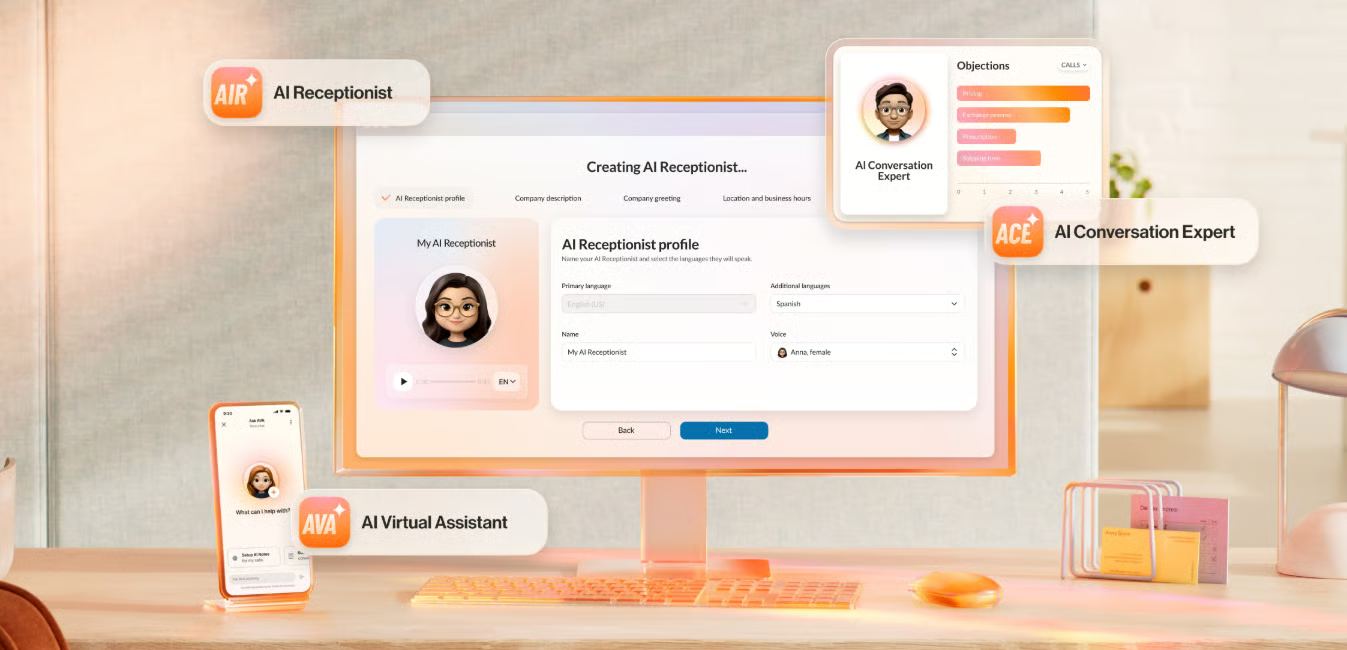
8×8 Work is also a strong call management platform, especially for global teams and organizations that may later expand into contact center workflows. It includes cloud calling, advanced routing, business texting, voicemail-to-email, auto attendant, intelligent call routing, ring groups, call queues, voicemail-to-text, call analytics, and post-call AI insights.
However, RingCentral is the better choice for small businesses that want the most flexible call management setup within a general UCaaS phone system.
Frequently asked questions (FAQs)
What is the main difference between 8×8 vs RingCentral?
The main difference between 8×8 and RingCentral is that 8×8 is often better for teams needing international calling and bundled contact center tools, while RingCentral is better for businesses wanting advanced collaboration, integrations, and scalable UCaaS features.
Does 8×8 or RingCentral have better video conferencing?
Both 8×8 and RingCentral include video conferencing, but RingCentral generally offers stronger collaboration tools for team meetings, messaging, and file sharing. 8×8 is a solid choice for teams that want video included with business phone and contact center features.
Who should choose 8×8 vs RingCentral?
Choose 8×8 if your business needs international calling, call center tools, or bundled communications features. Choose RingCentral if you want a highly scalable UCaaS platform with robust integrations, team messaging, and advanced call management.
Bottom line
In my head-to-head comparison, I found RingCentral to be the clear winner with its robust third-party integrations, video conferencing capabilities, and advanced call management features. But I still recommend 8×8 for home offices and smaller teams that want to unlock as many features as possible at a lower monthly price, as well as for teams engaged in international calling.
You might also like
The Best VoIP for Small Businesses in 2026
7 Best Cloud Contact Center Providers for 2026
Business Landline Systems: Cost, Features & Alternatives